
Lawrence City Directory Collections by Era
Lawrence city directories survive through several institutions, but none of the public collection descriptions supplies a complete annual shelf list. The strongest broad bibliography places various Lawrence publishers between 1847 and 1980. The Lawrence Public Library holds historical volumes and newspaper microfilm in Special Collections. The Boston Public Library and Massachusetts State Library list selected runs, while established genealogy and book collections offer selected digitized years. Treat each volume as a dated source, and ask staff to confirm the year before making a trip or relying on a gap in the run.
| Collection | Years | Where Held | Access |
|---|---|---|---|
| Lawrence city directories, various publishers | 1847-1980 bibliographic coverage | Lawrence Public Library, Boston Public Library, and Massachusetts State Library | Selected reference holdings; confirm the individual year |
| House-guide and reverse directories | 1915-1969 selected years | Massachusetts State Library and library reference collections | Address-to-occupant research; exact volumes need confirmation |
| Lawrence directory digitized record | 1932 | Google Books, from a New York Public Library original | Online metadata and searchable snippets |
| Telephone directories and Eagle Tribune microfilm | Years not publicly listed | Lawrence Public Library Special Collections | In-library consultation; ask staff about the requested year |
The table shows access routes, not uninterrupted coverage. A missing search hit can mean the desired year is not in a particular service, the name was abbreviated, or the household was not listed. The library, State Library, and Boston collection references should be checked separately. FamilySearch and Ancestry collections are useful selected-image channels, but access conditions and year availability should be verified through the relevant library or service at the time of research.
Google Books' 1932 Lawrence directory record shows the digitized collection record and searchable snippets for one volume.
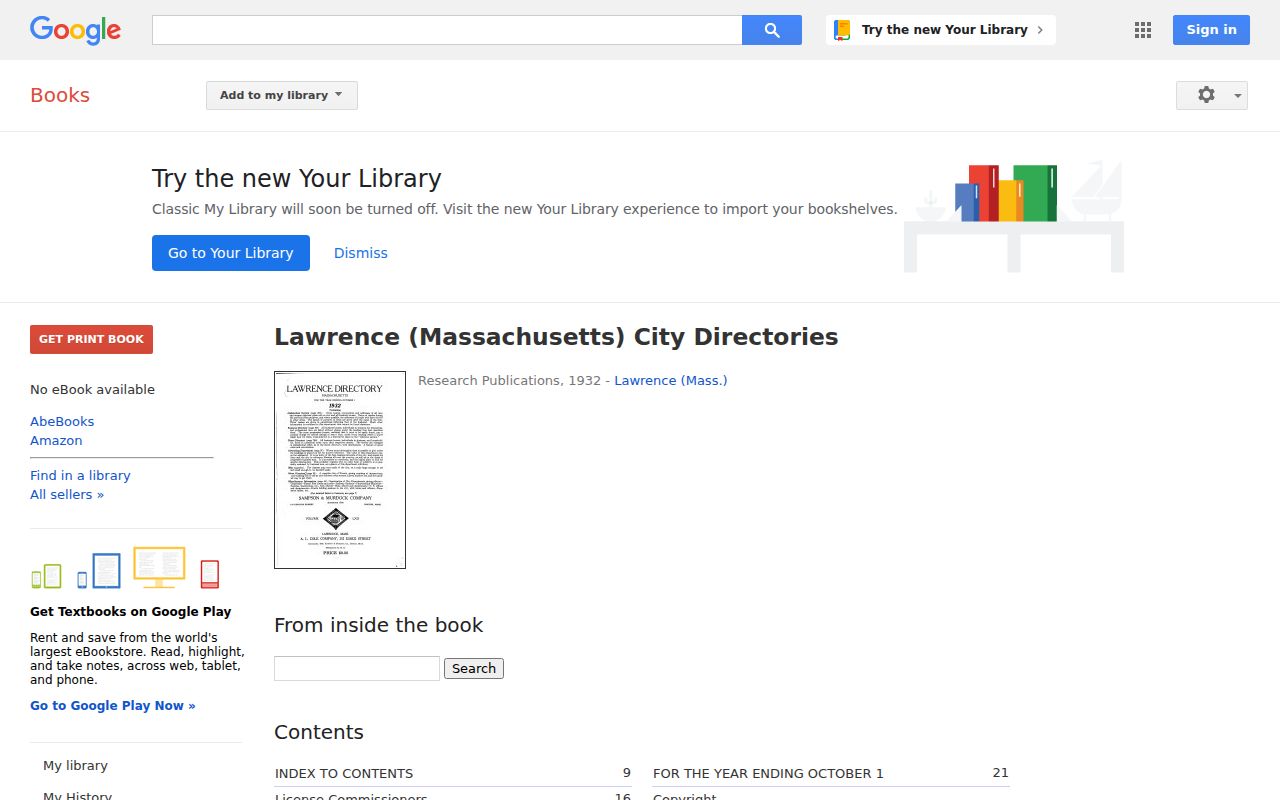
The record makes the 1932 book a useful format check, but it does not establish a complete digital run of Lawrence volumes.
Lawrence Historical Directories in the Mill Era
The long directory span begins near Lawrence's formation from parts of Methuen and Andover. Lawrence became a town in 1847 and a city in 1853; the Great Stone Dam was completed in 1848 and the first mills began operating in 1849. Those changes help explain why early Lawrence volumes can contain mill corridors, company neighborhoods, boarding-house language, and institutions that do not appear in a modern parcel record. A name from an early volume may also need to be checked against Methuen or Andover sources when the event predates Lawrence's municipal boundary.
Historical search work benefits from keeping the book's terms intact. The directory can point to a surname variant, a trade, a street, or a local institution. It cannot prove every member of a household or resolve a common name alone. The Lawrence History Center's local histories, its finding aids, and municipal reports can add context when a directory mentions a mill, church, labor organization, or civic body. Preserve the printed spelling, year, page, and the volume's title before comparing entries across collections.
Lawrence Historical Directory Shelf Access
Lawrence Public Library Special Collections is the practical fallback when an online search does not expose the needed year. Local History materials are on the second floor, archives are on the third floor, and microfilm readers are on the second floor. The materials are non-circulating, so they are consulted in the building rather than taken home. Historical directories sit beside maps, local genealogy material, cemetery lots and maps, photographs, manuscripts, and Lawrence Eagle Tribune microfilm. The library is at 51 Lawrence Street, and Special Collections lists Jaden Belizaire at 978-620-3615 for collection questions.
Bring a surname with spelling variants, a street name, and a small date range. Ask whether the requested Lawrence volume, reverse directory, telephone book, street list, or newspaper year is available and whether copying or photography is permitted. City Hall follows a different genealogy process and does not permit public self-searching of its vital-record material, so the library reading room is the better route for directory and microfilm research.
Lawrence Public Library Special Collections identifies the local-history rooms, microfilm readers, directories, and newspaper resources available for in-building research.
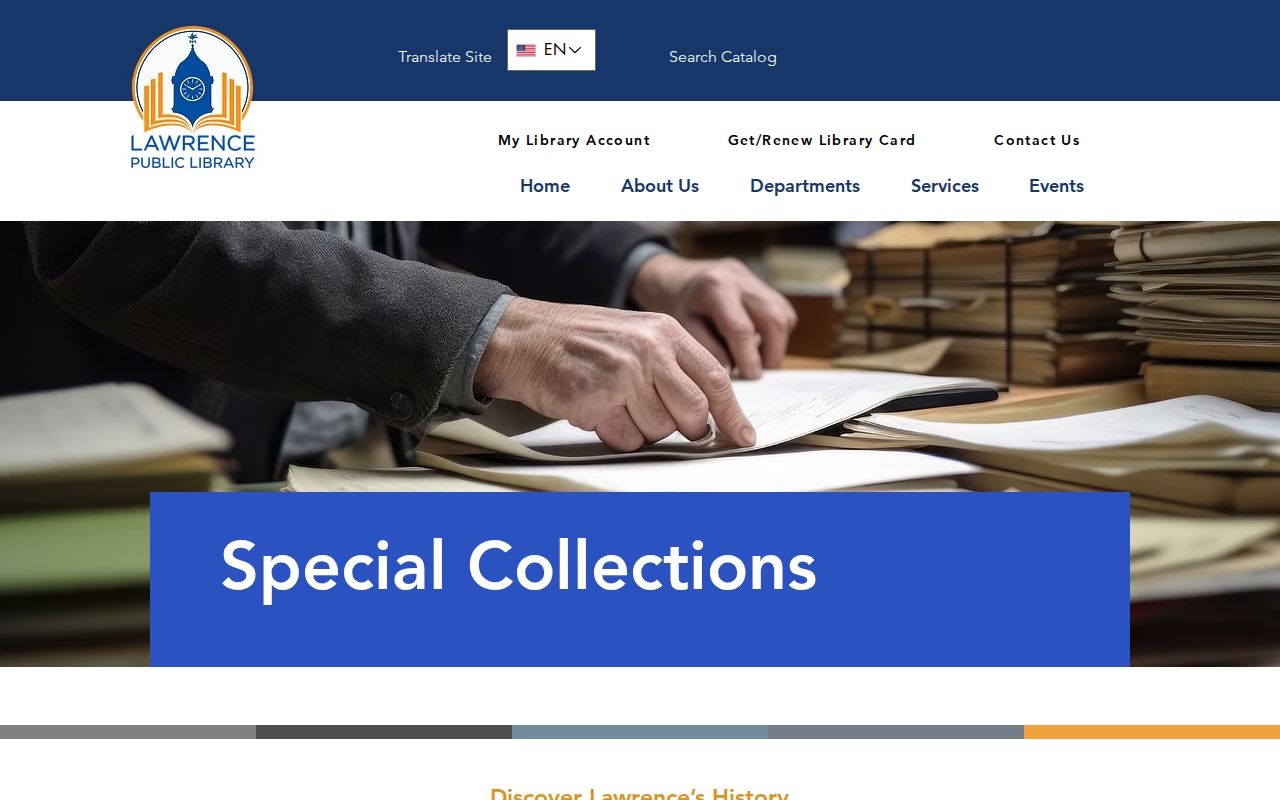
The Special Collections screen is a reminder to confirm the exact directory year with staff, since the public page does not publish a full shelf inventory.
The 1932 Lawrence Directory Sample
The digitized 1932 Lawrence directory is a working example of how much more than a name list can appear in one volume. Its record identifies Research Publications as publisher and the New York Public Library as original source. Searchable metadata surfaces contents, a License Commissioners heading, a year-ending section, and resident and business material. The usable evidence is in the printed entry and its key, not in a loose expansion of old abbreviations. Initials and shortened given names can make a familiar surname look unfamiliar.
OCR snippets display shortened forms such as Chas, Edwd, and Patk, as well as trade abbreviations such as carp, mach, weaver, and opr. An h marker appears for a home address, while the volume distinguishes people who board from people associated with a house. The exact meaning of an abbreviation can shift with the volume. Read its own key before transcribing the entry or making a family connection. A directory is also compiled at intervals, which means it can omit transient residents and retain wording that is now obsolete.
Note: Record abbreviations exactly as printed first, then use the volume's key and a second local source before expanding a name or household relationship.
Reading a Lawrence City Directory Entry
A Lawrence city directory entry should be copied as a small inventory rather than paraphrased in a research note. The surname and abbreviated given name are only the starting point. The address, listed trade, house or boarding notation, and any nearby organizational or business context help separate one person from another with a similar name. A spouse or widow notation can be a strong lead when present, but it is still a printed representation, not a vital record. Use the entry's year as part of every citation.
| Name form | Copy surname, initials, and shortened given name exactly as printed, including punctuation. |
|---|---|
| Listed trade | Preserve the abbreviation and consult that volume's key before writing out a meaning. |
| Address marker | Record the street and number, plus an h, house, or boards distinction where shown. |
| Relationship notation | Copy a spouse or widow notation precisely, then test it against an independent record. |
| Entry context | Note page, directory year, and nearby business or institution references that identify the person. |
- Criss-cross directory
- A reverse or street-order section that starts with an address and helps identify the listed occupant or business at that location.
- Householder index
- An index organized around the person or household associated with an address, rather than a complete census of everyone inside.
- Abbreviation key
- The volume's own explanation of shortened names, trades, and marks. Photograph or transcribe it before interpreting an entry.
Lawrence City Directory Address Guides
Selected Massachusetts State Library house-guide and reverse directories cover 1915 through 1969. These address-oriented volumes are valuable when the street is known but the surname is not. Start with the street and house number in the reverse section, then turn back to the alphabetical section to see the fuller entry. Compare at least two nearby years before treating an apparent change as a move. Street numbers, spellings, and city boundaries need their own checks.
For a current address question, historical directory evidence should remain separate from the modern property trail. The city assessor and Northern Essex Registry records serve different purposes from a historical listing. A name in a reverse book shows an occupant or association for that directory year; it does not establish legal ownership. The modern address workflow is covered in the Lawrence by-street directory, where parcel and deed records are kept distinct from historical household clues.
Lawrence Directories and Newspaper Trails
A directory gap or sudden address change often leads to the newspaper reel rather than another index. Lawrence Public Library holds Lawrence Eagle Tribune microfilm, and the Lawrence History Center preserves selected archives, photographs, and finding aids. Search a full name, a street, a mill or company name, a funeral notice, a marriage announcement, a probate notice, or a civic organization. The newspaper may explain why a person appears under a new address, while the directory gives the year-by-year neighborhood placement.
The Lawrence History Center also points researchers to Digital Commonwealth, the Digital Public Library of America, Internet Archive, and the Portuguese-American Digital Archive. Its collections include textile, labor, immigration, institutional, and local-genealogy materials. These are companions to the printed volumes, not replacements for them. Find the item or finding aid first, then ask the History Center about the appropriate research-contact route or an appointment at its 6 Essex Street research room.
Lawrence History Center digital collections lists the online channels and collection themes that can supply context for a directory name or address.
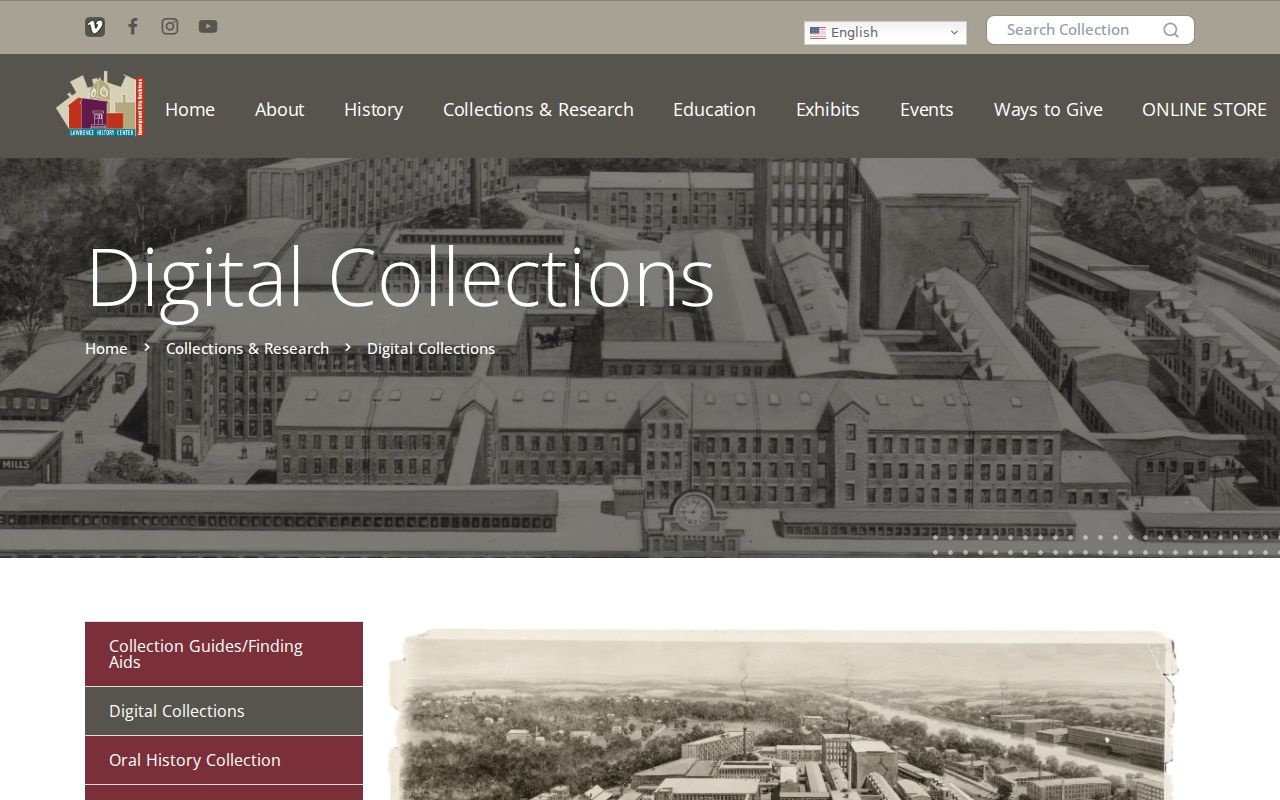
Digital collections can add a photograph, organization, or local-history lead, while library volumes and microfilm remain important access channels for directories and newspapers.
Tracing Lawrence Households by Directory Year
Follow a household across Lawrence volumes one year at a time. Start with a name and a plausible date range, then preserve each spelling, address, printed trade, and relationship mark. The directory years are especially helpful between federal censuses. Federal census records are public through 1950 under the 72-year release rule, so a directory can bridge the years before and after a census household. Do not merge two same-name people merely because they appear on the same street.
- Locate the surname in an alphabetical Lawrence directory and copy the entry exactly, including the year and page.
- Check the next available directory year, then work backward and forward to record changes in spelling, trade, address, or household notation.
- Open the reverse or criss-cross section for the same year when available, and record the address-order listing separately.
- Pair the directory sequence with the nearest available federal census, keeping the directory's date and the census date in separate columns.
- Use newspaper microfilm, Bellevue burial material, probate, vital records, or deeds to test whether a disappearance reflects a move, death, or an unlisted year.
An absence has several possible meanings. The household may have moved, the person may have died, the name may be indexed differently, or the directory year may be unavailable. The Lawrence burial search and the library's cemetery materials are useful former-resident endpoints, but a burial result documents interment rather than a complete residence history. When a historical entry needs a present-day identity check, use the Lawrence resident lookup workflow and compare independent records carefully.
Lawrence Directory Maps and Boundaries
Street research benefits from a map, but the map must match the directory year as closely as possible. The 1875 City Atlas, city reports, directories, and later assessment material use different lot, block, address, and administrative systems. Keep the identifier supplied by each source instead of silently converting it to a current address. The Library of Congress and local library or History Center holdings are the appropriate places to ask about maps and physical availability. A confirmed year-by-year local Sanborn list was not found in the reviewed sources.
Lawrence's boundary history adds another caution. The city was created from parts of Methuen and Andover, and early names may surface in those communities' records. Mill, canal, river, South Lawrence, North Lawrence, Tower Hill, Mount Vernon, and other local labels can also appear differently across records. Those terms help build a search list, but they are not a substitute for a verified municipal boundary or street address.
Lawrence City Directories Online and In Person
Online access is useful, but it is only one channel. Google Books supplies a documented 1932 record; selected images appear through established genealogy and library collections; and Lawrence History Center digital links lead to several partner repositories. For a missing year, the fallback chain is the Lawrence Public Library reading room and microfilm readers, then the Massachusetts State Library or Boston Public Library reference collections, followed by the Lawrence History Center for local archive context. Staff can confirm shelf or call-number details that public pages leave open.
Use the library catalog and a precise request rather than asking for every record about a family. A useful request states the surname variants, street, desired year range, and whether the need is a historical volume, reverse directory, telephone book, newspaper reel, atlas, or city report. The March 2026 City Clerk genealogy policy is separate: it concerns Lawrence vital events, does not allow public self-searching, and should not be confused with library directory access. Personal, lawful historical research also requires respecting restricted records and private information.
Note: A historical directory is strongest when its year, page, spelling, and address are preserved beside the independent source used to confirm the family connection.