
What Lawrence Resident Lookup Covers
Lawrence has no single official resident list. The useful record is the one that answers the question at hand. An assessor card identifies a current municipal owner and separates the parcel's physical address, or situs, from its tax-mailing address. A local voter register is a separate civic record, subject to protected-voter rules. A court docket, the court's running case record, identifies a party and public case activity, not a current address. Vital, probate, cemetery, business, and license records each carry their own dates, custodian, and access rules. Keeping those categories apart prevents a loose name match from becoming an unsupported claim.
| Record | What It Confirms | Where | Access |
|---|---|---|---|
| Assessor parcel | Owner, situs, mailing address, parcel context | Lawrence Assessing Online | Public online or Assessor counter; owner is not automatically an occupant. |
| Local voter register | Available public name, residence, party, and status fields | Lawrence Election Division | Local request, with confidential and protected exceptions. |
| Court docket | Party, case number, event history, and public outcome | MassCourts | Online, courthouse kiosk, clerk counter, or file request. |
| Vital record | Event identity and family relationship | Lawrence City Clerk, RVRS, or State Archives | Eligibility, event location, and age of record control access. |
| License or filing | Credential or public business affiliation | Massachusetts license search | Public verification; an office address is not home-address proof. |
Start with the strongest verified fact, then add only a record that can independently test it. A person connected to a parcel may be checked against the newest recorded instrument. A former resident is better tested through a dated directory, obituary, cemetery entry, probate filing, or vital record. A name that appears only once should stay a lead. The Past Residents directory is the more suitable route when the question is an old address rather than a present-day identity.
Lawrence Records Answer Different Questions
An assessor result can show a recorded owner and a mailing address, but it cannot establish who occupies the property. A deed or Registry index shows parties to a land transaction and legal description, not a household list. A voter record can be public locally while the statewide central voter registry remains unavailable as a public record under Massachusetts law. The Secretary's individual status form requires a person's first and last name, full date of birth, residential ZIP, and agreement checkbox. It is designed for the individual's own registration status, not a surname-only or ZIP-wide people search.
Use a date beside every finding. Lawrence is served by municipal offices, an Essex court venue, the Northern Essex Registry district, and postal ZIP assignments that do not share the same boundaries. A result filed in a neighboring municipality or another court department may concern the right person, while a Lawrence label alone may not be enough. Preserve a no-match, restricted, not-held-here, and not-searched result separately. Those labels make a later review possible without filling a gap with a guess.
Massachusetts unclaimed-property search accepts a name and address to locate a possible state-held claim or heir lead.
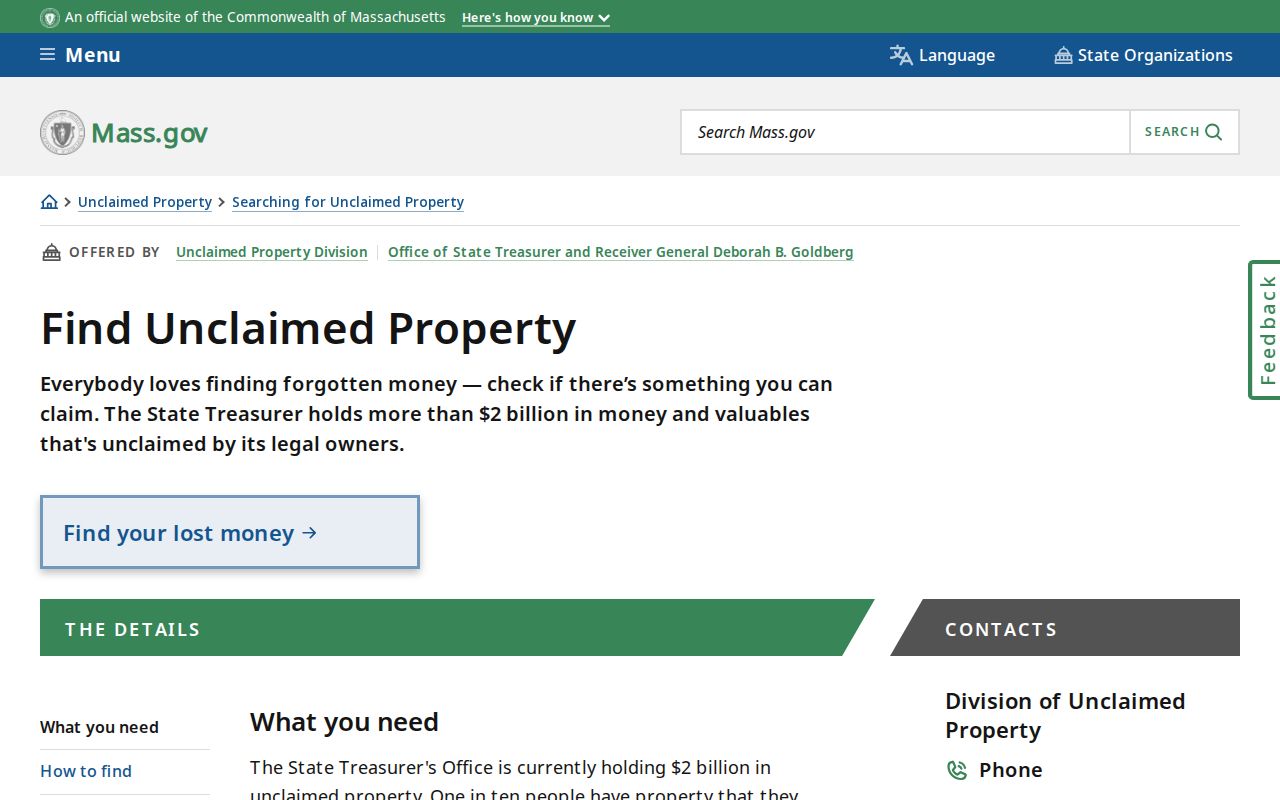
An unclaimed-property result is a name-and-address claim lead requiring proof, not an address locator.
Search Lawrence Court Records
MassCourts search instructions require a court department first, then the relevant division and, where available, location. Lawrence District Court serves Lawrence, Andover, Methuen, and North Andover. Essex Superior Court in Lawrence serves the county, while Essex Probate and Family Court files need the Probate and Family department. Search the name tab with spelling variants, or use the case-number tab when a notice already supplies the docket. Exact capitalization, spaces, and leading zeroes matter in case-number searches.
| MassCourts result item | What it means |
|---|---|
| Case number and caption | The court's identifying number and the named parties in the case. |
| Department, division, and location | Which court system and courthouse route the record belongs to. |
| Filing date and case type | When the case entered the court and its public category. |
| Docket entries | Chronological filings, hearings, orders, judgments, and events that are publicly visible. |
| Document access | A docket display may not include every image; the clerk or public kiosk can be the next route. |
Compare party role, dates, location, attorney, public address information, and reported outcome before treating a docket result as a match. Probate and Family online cases generally reach back to 2000, but older or department-specific material can require the courthouse kiosk, clerk counter, or a request for the physical or electronic file. Juvenile, adoption, sealed, impounded, and protected-identifier material may be withheld. A missing PDF does not prove a case never existed.
Note: Keep the department, division, location, and case number with each result because Essex matters can use different Lawrence court routes.
Verify a Lawrence Resident
A careful resident lookup tests one person through records that are independent and suited to the question. Begin with an exact name and a dated Lawrence connection. Check the parcel only when ownership matters, not as a shortcut for occupancy. Then compare the court or vital trail with its proper custodian. If a record conflicts, retain both dates and descriptions rather than selecting the more convenient result.
- Write down the full name, middle initial or surname variant, approximate year, relationship, and the known Lawrence address or prior street. Keep the original spelling beside any normalized version.
- If there is a property connection, use the assessor card to record the owner, situs, mailing address, parcel identifier, and deed reference. Label an owner as an owner, because a different person may live at the situs.
- Run a MassCourts party search in the department, division, and location that fit the record. Compare the case caption, party role, timeline, public docket events, and disposition with the facts already known.
- For a death, marriage, or family relationship, route the request by event location and date. Request a certified copy, the custodian's official copy, only when eligibility permits, and retain a negative statement if no record is found.
- Docket
- A court's running record of a case, listing the caption, case number, filings, events, orders, and judgments that are publicly available.
- Index versus image
- An index is a searchable record of key fields. An image is the underlying document or page. A search result may point to an image without displaying it remotely.
- Certified copy
- A copy issued and certified by the court, vital-record office, or other custodian. It is different from an informal index result or ordinary download.
A same-name collision deserves a pause. Compare a middle initial, year, street, relationship, party role, and time sequence before joining two records. Correct a voter-list error through the registrars with proof, and take assessor, Registry, or docket errors to the office that issued the record.
Lawrence Vital Records Need Routing
Lawrence City Clerk genealogy policy applies only when the birth, death, or marriage event occurred in Lawrence. Living in Lawrence does not place an event held in Methuen, Andover, North Andover, or another community in the Clerk's files. The Clerk does not permit public self-searching. For up to three documents with accurate names and exact dates, the local policy states no research fee and a $10 charge per certified copy. Four or more documents, or incomplete or inaccurate name or date information, triggers a $50 research fee plus the copy charge. The stated target for genealogy requests is ten business days.
Massachusetts vital-record access guidance explains that birth and marriage records generally become public after 90 years and death records after 50 years, subject to particular restrictions. RVRS handles statewide records from 1936 forward, while the State Archives holds the statewide historic series for 1841 through 1925. A state mail request needs the event information known, identification and eligibility material where required, payment, and a prepaid return envelope. The current RVRS schedule also describes in-person, standard-mail, and expedited-mail service. A negative statement is useful evidence of the search performed, not proof that an event never occurred elsewhere.
The state vital-record page shows the access and eligibility rules that control a Lawrence resident lookup request.
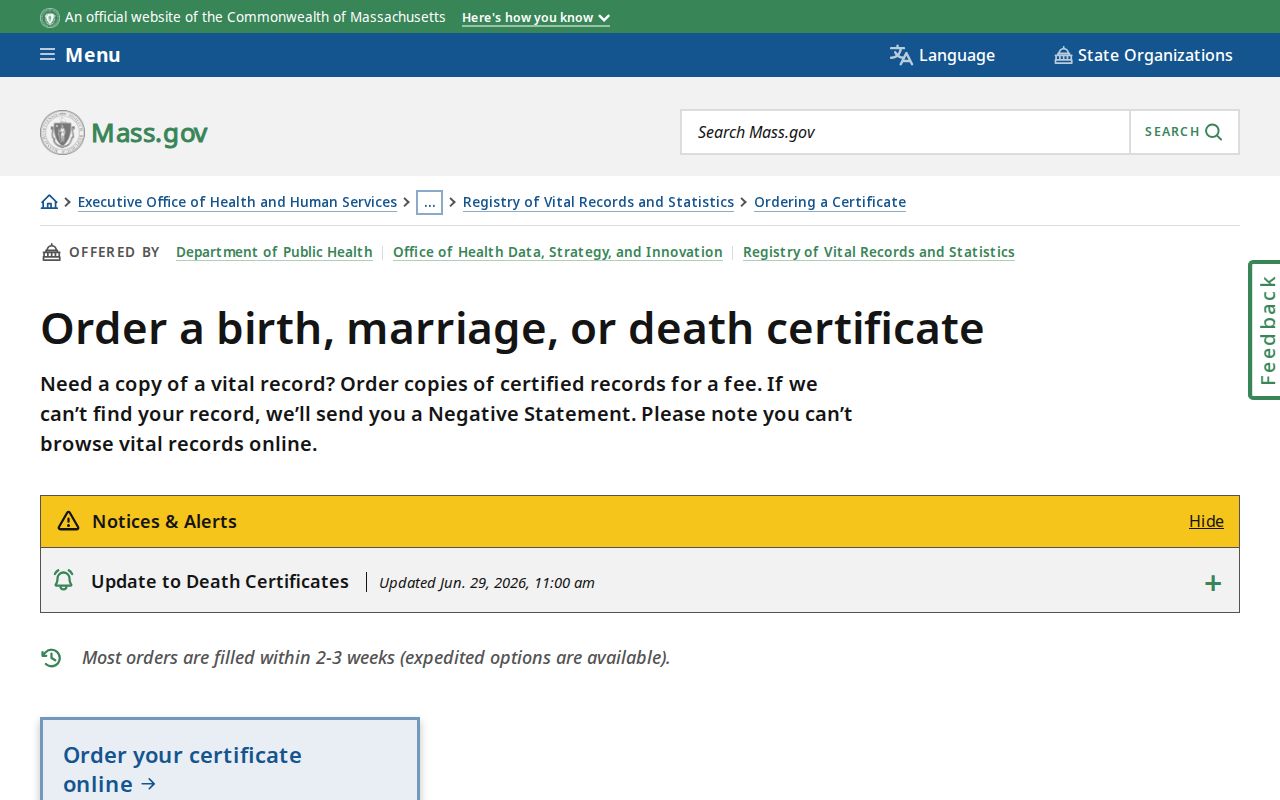
Restricted birth, adoption, and death-identifier material must remain with the authorized custodian and process.
Lawrence Voter Records: Local Access
The statewide voter registry is not a public download, even though local annual registers are generally public under the Massachusetts framework. Contact the Lawrence Election Division for a local annual register or voter-record request, stating the year, ward or precinct if known, record type, and preferred format. The city maintains election records through the City Clerk and Board of Registrars. Public local fields may include name, address, party, date of birth, active or inactive status, voter ID, and certain dated registration details. Phone, email, veteran status, permanent-absentee status, confidential records, minors, and protected voters are not ordinary public fields.
Massachusetts My Voter Registration Status is an individual form requiring first name, last name, month, day, year of birth, a five-digit residential ZIP, and an agreement checkbox.
The form is a personal registration-status check, not a statewide public resident-search screen.
Note: A local annual-register request and the individual-status form serve distinct lawful purposes and should not be treated as one record.
Lawrence Former Resident Endpoints
For a deceased or former Lawrence resident, combine dated sources instead of forcing a current-location conclusion. A probate case can identify a decedent, personal representative, attorney, and public filings where visible. Lawrence Public Library newspapers and local-history materials can help locate an obituary or historical address trail. The burial record is an endpoint for death and interment, not proof of a current residence. It can still help distinguish people with the same name when dates, cemetery, plot location, and family context line up.
Lawrence's burial search includes first, middle, and last-name searching with cemetery, veteran, service, date, variant, location, and memorial fields.
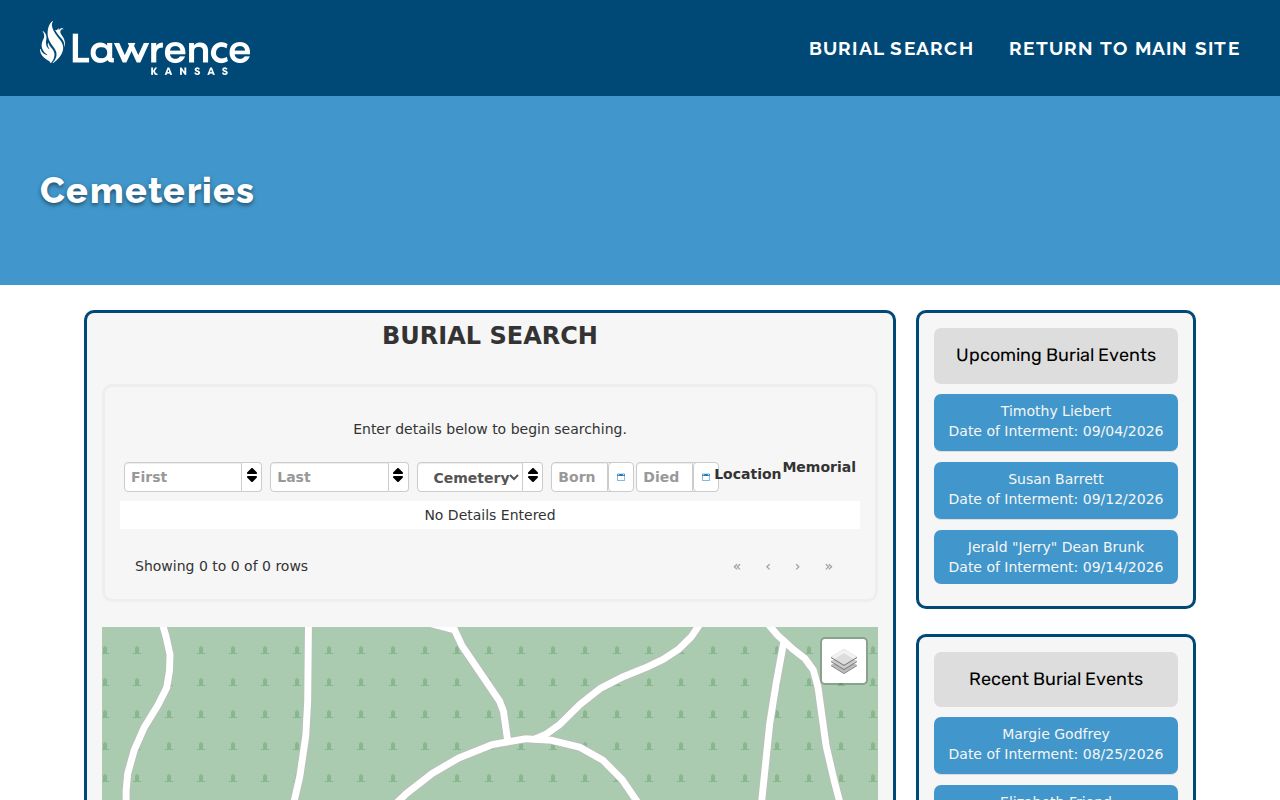
Veteran rank, branch, war-service, mapped location, and memorial fields can add context without turning an interment result into a current-address claim.
Lawrence License Record Checks
Business and license records can test a public affiliation after a name match, but they do not establish a person's home. The Secretary of the Commonwealth corporate database can show dated entity filings, registered agent or office, officers or managers where displayed, annual reports, amendments, and dissolution. A Lawrence DBA certificate belongs with the City Clerk record route and may not appear in the state corporation database. Massachusetts DOL eLIPSE searches by person or business, name, city, state, ZIP, board, license type, or license number. DPH health-profession verification instead accepts a last name or license number. Compare the board, credential number, status, and date before connecting a license hit to a Lawrence resident.
Use public affiliation records as a dated corroborating signal. A registered-agent or principal-office address belongs to the entity filing, and a credential result belongs to the licensing board. Neither alone settles a residence question. Local permits and DBA certificates can add a Lawrence connection, but their live public fields and historical coverage need confirmation from the City Clerk or the relevant city department.
Requesting Lawrence Records
When the online route lacks the needed year or field, direct a written request to the actual Lawrence custodian. Massachusetts Public Records Law, M.G.L. c. 66, § 10, permits requests to custodians, while exemptions and 950 CMR 32.00 rules still limit what may be released. Identify one office and one record family, such as an Election Division annual register for a stated year or a City Clerk record for a named event. Include the date range, Lawrence department, desired electronic format, contact information, and a fee ceiling or request for an estimate. A broad demand for every record about a person does not identify a usable record set.
Requests may be made electronically, by mail, or in person, but the state guidance prefers writing because an oral request cannot use the same appeal path. Retain the response, production date, fee estimate, and any cited exemption. For vital records, use the City Clerk counter, mail, telephone card payment, or the city's online payment route only after confirming that Lawrence was the event location. For court files, use MassCourts, a courthouse public terminal, the clerk counter, or a copy request. For an offline historical trail, use the library's microfilm and archive access rather than assuming an online index is complete.
Note: A precise custodian, record type, and date range make a Lawrence request easier to evaluate and preserve the right record boundary.
Limits on Lawrence Resident Lookup
Massachusetts Address Confidentiality Program participants use a substitute address, and that protection must not be reverse-engineered from older property, voter, court, or directory entries. Protected voter records, minors' records, phone and email fields, sealed or impounded court material, juvenile and adoption files, medical information, utility data, DMV addresses, and private association lists have separate limits. A public image can also contain protected identifiers that are subject to redaction practice. If a record appears wrong or protected, contact the issuing custodian, the voter-protection process, ACP, or the court's impoundment route rather than republishing it.
Public does not mean complete, current, or permission to republish every available field. Keep the source date, custodian, scope, and limit alongside every record-derived note. That context also prevents a historical directory line, an old deed mailing address, or a cemetery entry from being presented as a current Lawrence residence.
Massachusetts sex-offender information describes public information that depends on the registry's classification rules.
Visibility is classification-limited, it is not a general resident search, and no result establishes identity without context.
Lawful use. Use Lawrence records for personal, lawful research such as family history, estate questions, civic curiosity, or reconnecting. Never use a record to stalk, harass, intimidate, or expose a protected address.